The Votive Shrines of Brenzone

Sacred art among streets and olive groves

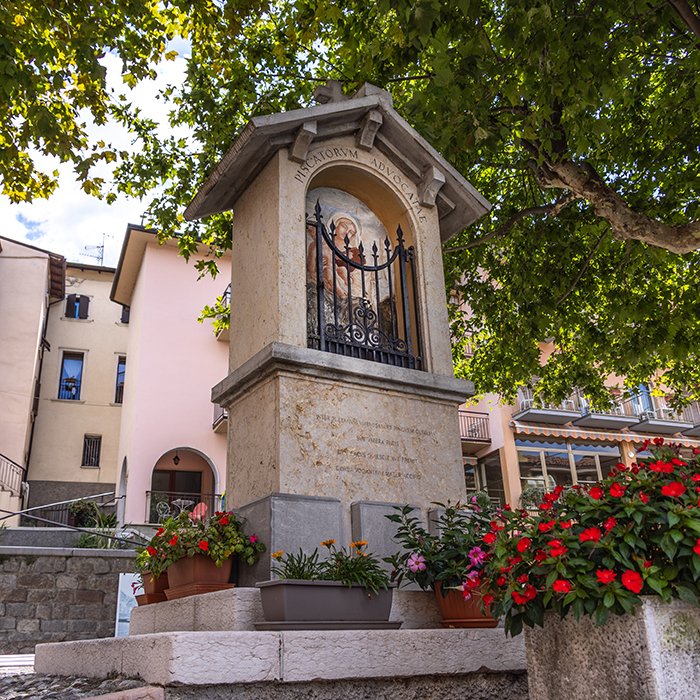
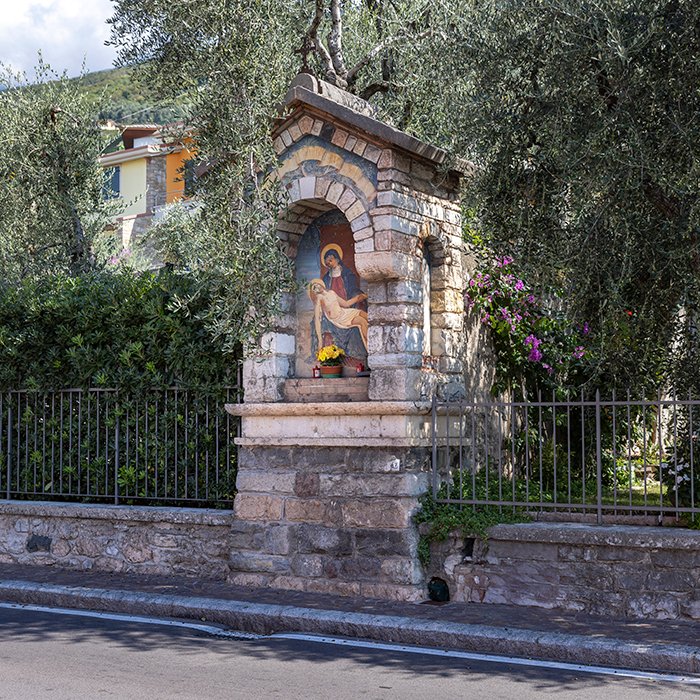
In the territory of Brenzone on Lake Garda, votive shrines, small shrines dedicated to the Madonna, Christ, or the saints, emerge as widespread testimonies of popular faith. Placed at crossroads, along country paths, or at village entrances, they represent not only spontaneous sacred art but also the living historical identity of a landscape shaped by community and tradition.

The streets of the votive shrines

Main shrines to explore

Capitello della Disciplina (or dei Caporali)
Magugnano, via della Disciplina

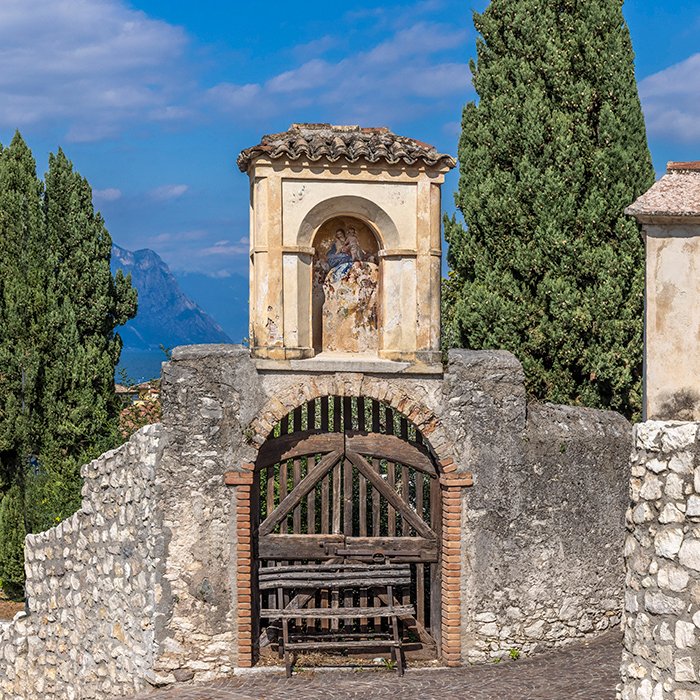
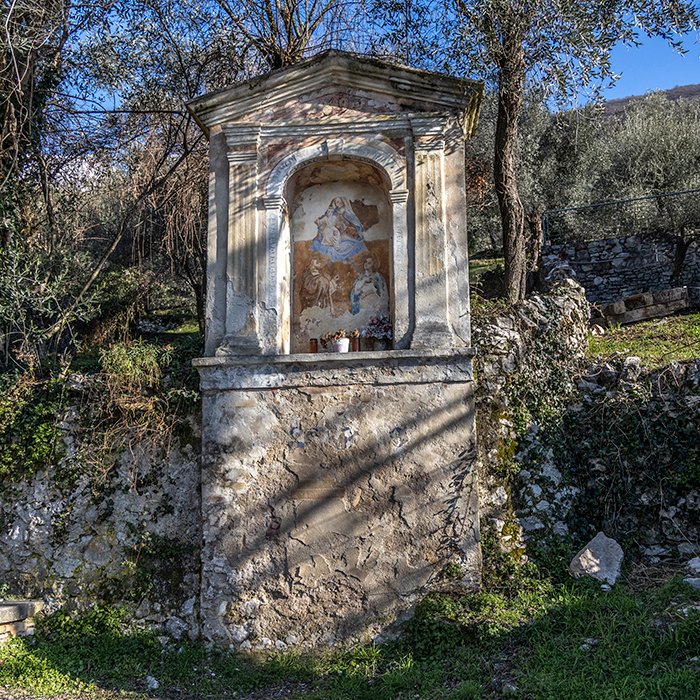
Located on Via della Disciplina in Magugnano, it dates back to the 18th century and features decorations attributed to the painter Bartolomeo Zeni (1740–1801). Restored in 1997, it stands above the entrance to an old walled garden (brolo), once cultivated with olive trees. In the central niche, the Madonna and Child are depicted, with at their feet a Holy Bishop (Zeno, Nicholas, or Virgilius), Saint Stephen, and Saint Lawrence.

Capitello della Madonna dell’Aiut
Marniga, via Madonna dell’Aiut

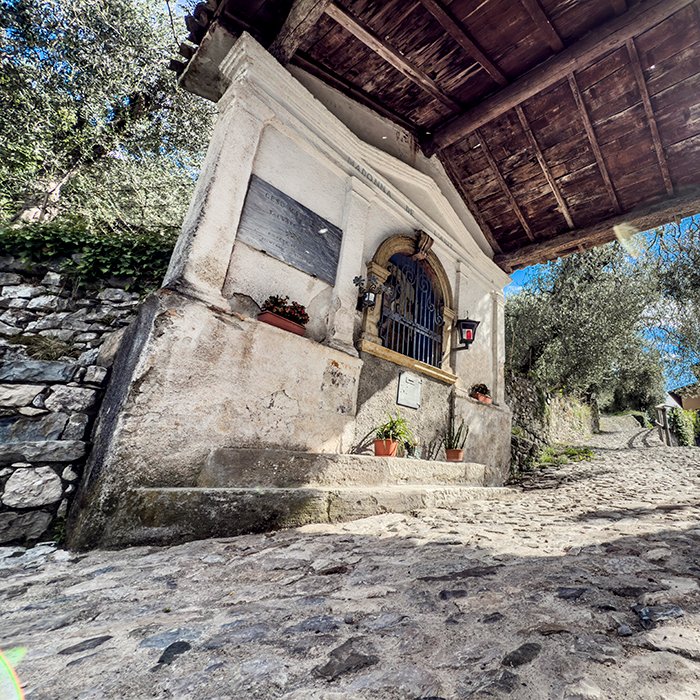
Along the ancient path leading to the medieval hamlet of Campo di Brenzone, the Madonna dell’Aiut Shrine (17th century) welcomes visitors with its protective roof. Restored in 1980, it now houses a wooden icon of the Madonna of Tenderness with Child, replacing the metal painting created by Ennio Berti in 1972. The original image was lost in an arson fire.

Capitello della Madonna Immacolata
Biaza

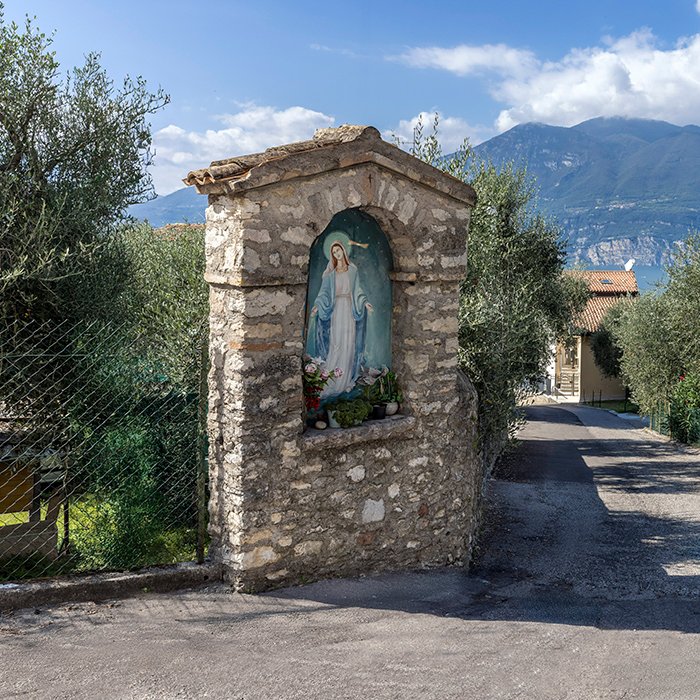
Set into a boundary wall, built in 1910 and restored in 2010. It depicts the Immaculate Virgin against a blue background, protected by a stone gabled roof with terracotta tiles. The niche highlights a painting portraying the Immaculate Conception, with rays emerging from the Virgin’s hands to symbolize the Graces.

Capitello Madonna con Bambino
Porto di Brenzone

Located on the harbor and built in the 1930s with the construction of the Gardesana road, the shrine has a double façade: one facing the lake, with the Madonna and Child and fish, and the other facing Mount Baldo, with the Madonna and Child and olive trees. In the lower section, a plaque commemorates the narrow escape from the air raid of 1 April 1945.

Capitello della Madonna Addolorata
Castelletto

Located on Via Vespucci, it was built in the 1930s during the widening of the Gardesana road. Constructed in local stone with a slab roof and a Rosso Verona base, it preserves in the central niche a fresco of Our Lady of Sorrows among olive trees. On the sides appear two figures: a Saint holding a book and Saint Zeno, bishop.

Capitello Madonna del Rosario
Fasor

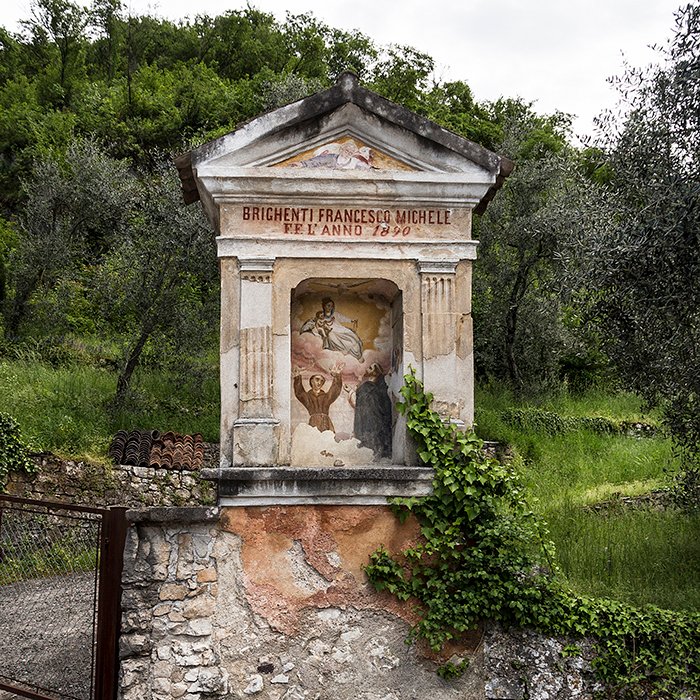
At the northern exit of Fasor stands the shrine of Our Lady of the Rosary (built in 1890 and restored in 1996), signed by Giuseppe Martini of Malcesine and commissioned by Brighenti Francesco Michele. In the niche are depicted Our Lady of the Rosary with the Child, Saint Francis, Saint Dominic, and on the side panels Saint Michael the Archangel and a female saint.

Capitello della Madonna del Carmine

Located near the hamlet of Zignago on the road to Sommavilla, this gabled wayside shrine bears the date 1890 and was painted by Giuseppe Martini of Malcesine. In the niche are depicted Our Lady of Mount Carmel, with Saint Dominic and Saint Lucy on either side; below the ledge the original inscription “AVE MARIA” was once visible. It was restored in 1998 by E. Signorini.

Capitello Maria Ausiliatrice

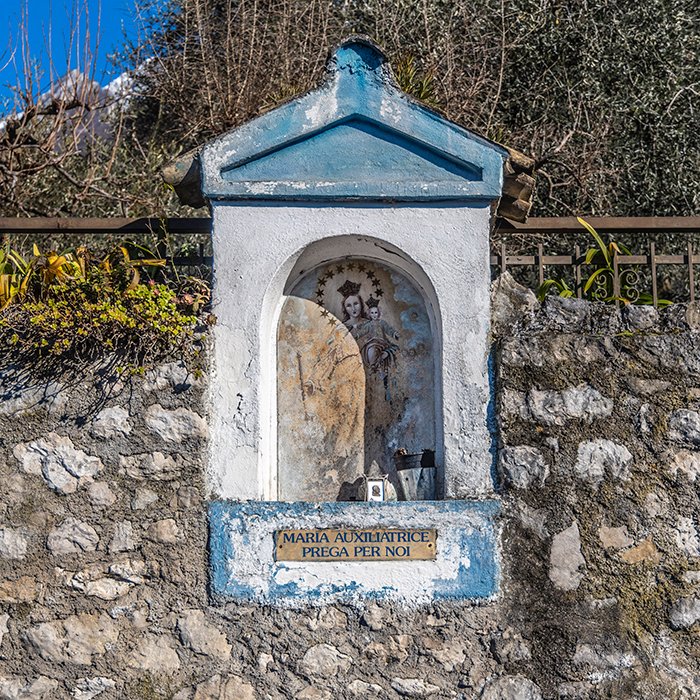
Located at the northern entrance of Sommavilla on Via Madonna degli Ulivi, it dates back to 1960 and has undergone several repainting interventions over time. The simple structure, covered with terracotta tiles, houses a half-fresco painting depicting Our Lady Help of Christians with a scepter, surrounded by little angels among the clouds.

These shrines can be freely visited during hikes or walks through the villages. Some hiking trails pass directly by them. For those wishing to explore further, the Tourism Office provides maps and themed itineraries.